Finding The Right Fit: Understanding Different Approaches to Therapy
Finding a new therapist can be incredibly overwhelming. You search “therapist near me,” and suddenly you’re faced with a sea of options, each offering a different approach with its own set of letters and language.
The hard part is that there isn’t one “right” type of therapy for everyone. Each approach offers a slightly different way of understanding what’s happening inside us and how healing can happen. Many different approaches might get you to where you want to be — you may have heard the phrase “there are many ways up a mountain”. Often, therapists blend several approaches to meet you where you are.
Below I have put together an overview of some common therapy approaches and what they look like in practice. Knowledge is power, and agency is important when it comes to taking care of your mental health. This might help you decide what kind of therapy might be most effective for you — but remember, what matters most is finding a therapist and an approach that feels like the right fit for you (read more about this here).
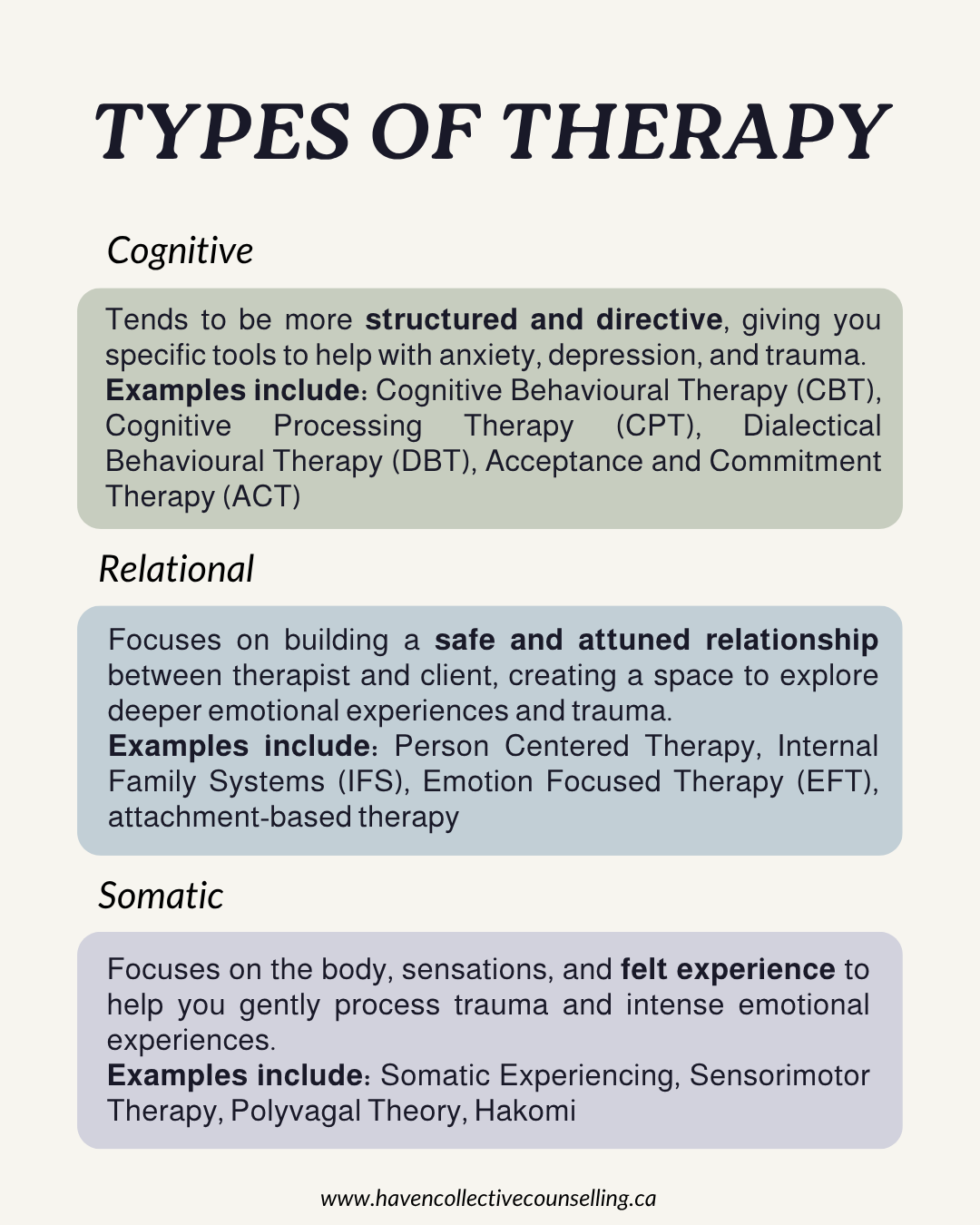
Cognitive Based Therapies
Cognitive Behavioural Therapy (CBT)
CBT is one of the most widely recognized approaches to therapy. It’s built on the idea that our thoughts, emotions, and behaviours are interconnected — and that by noticing and shifting our thought patterns, we can change how we feel and act.
In a CBT session, you might work with your therapist to identify automatic negative thoughts or cognitive distortions (like black-and-white thinking or catastrophizing). Together, you’d explore how those thoughts impact your mood and behaviour, and practice reframing them in more balanced ways.
It’s structured, goal-oriented, and often includes practical tools or “homework” between sessions. CBT can be particularly effective for anxiety, depression, and stress management — especially if you appreciate concrete strategies and clear structure.
This might not be the right fit if you’re looking to explore deeper emotional or relational patterns rather than focusing on symptom management. Some people find CBT can feel a bit impersonal or overly focused on logic when what they need most is emotional connection and validation.
Dialectical Behaviour Therapy (DBT)
DBT was originally developed to support people who experience intense emotions or struggle in relationships. It combines elements of CBT with mindfulness and acceptance-based skills.
DBT focuses on four key areas: mindfulness, distress tolerance, emotional regulation, and interpersonal effectiveness. In therapy, you might learn to notice your emotions without judgment, practice grounding techniques during moments of overwhelm, or develop new ways to communicate your needs.
Many people find DBT helpful if they’ve felt “too emotional” or misunderstood in the past, or if they swing between extremes — like closeness and withdrawal, control and chaos, self-criticism and numbness. It teaches emotional skills while holding deep compassion for your experience.
This might not be the right fit if you’re not drawn to a skills-based or structured approach. Some clients find DBT too structured or “classroom-like,” especially if they’re looking for a more exploratory, relational process.
Acceptance and Commitment Therapy (ACT)
ACT helps you make room for difficult emotions while still moving toward what matters most to you. Instead of trying to eliminate painful thoughts or feelings, ACT focuses on building a more flexible relationship with them.
In practice, this might mean learning mindfulness exercises that help you notice your thoughts rather than getting caught in them, or clarifying your personal values so you can take small steps aligned with what you care about.
ACT is particularly helpful if you tend to feel stuck in avoidance or perfectionism, or if you’ve tried to “fix” your feelings without much relief. It invites a gentler approach: making space for the full range of your human experience while still living meaningfully.
This might not be the right fit if you want more direct focus on your past or the roots of your struggles. ACT tends to focus more on the here-and-now than on processing deeper trauma or early experiences, which some people find limiting.
Relational, Experiential and Emotion-Focused Therapies
Person-Centered Therapy
Person-centered therapy is built on the belief that healing happens within a safe, accepting relationship — one where you feel deeply seen and valued for who you are. Developed by Carl Rogers, this approach emphasizes empathy, genuineness, and unconditional positive regard. Rather than directing or interpreting, your therapist offers a grounded, compassionate presence that helps you reconnect with your own inner wisdom and capacity for growth.
Rogers famously said, “The curious paradox is that when I accept myself just as I am, then I can change.” That idea sits at the heart of person-centered therapy — the understanding that acceptance, not pressure, is what allows true transformation to unfold.
This approach has become the foundation for most modern styles of therapy, influencing everything from emotion-focused work to trauma-informed care. It’s especially supportive if you’ve felt judged, dismissed, or misunderstood in the past, and need a space where you can simply be yourself.
It might not be the right fit if you’re looking for a highly structured or technique-driven approach. Because the process is led by your pace and experience, change can feel subtle and gradual rather than directive or task-focused.
Attachment-Based Therapy
Attachment-based therapy explores how your early relationships shaped your sense of safety, trust, and self-worth — and how those patterns might show up today.
In sessions, the therapeutic relationship itself often becomes a place to experience repair. When your therapist consistently meets you with care, patience, and attunement, it can begin to shift deeply held beliefs like “I’m too much” or “people always leave.”
This approach is especially supportive for people who struggle with relational anxiety, people-pleasing, or fears of abandonment. It helps you build a secure base within yourself, while also learning to form healthier, more authentic connections with others.
This might not be the right fit if you’re hoping for a highly skills-based or short-term approach. Because attachment patterns develop over time, healing them often requires patience, consistency, and a longer-term therapeutic relationship.
Internal Family Systems (IFS)
IFS is a compassionate and deeply humanistic approach based on the idea that we all have different “parts” within us — protective parts, wounded parts, and parts that hold wisdom and strength.
In an IFS session, you might begin to notice and get curious about your inner world: the part that feels anxious, the one that criticizes, the one that shuts down. Instead of trying to change or silence these parts, the focus is on understanding them — learning what each one is trying to do for you, and helping them unburden old pain or fears.
IFS can be transformative for people who struggle with shame, self-criticism, or inner conflict. It’s gentle, non-pathologizing, and helps you cultivate a sense of internal safety and self-leadership.
This might not be the right fit if you prefer a highly structured or skills-based approach. IFS is more exploratory and intuitive, which can feel abstract or slow-paced to those looking for more concrete, skill-based strategies.
Somatic or Body-Based Therapies
Somatic therapies are grounded in the understanding that our bodies hold stories our minds may not yet have words for. They explore how trauma, stress, and emotion live in the body — through tension, posture, breath, or subtle sensations — and use gentle awareness to help release what’s been held.
In sessions, your therapist might guide you to notice physical sensations as you talk about an experience — a tightening in the chest, a lump in the throat, or a softening in the shoulders — and help you stay present with those sensations in a way that feels safe. This mindful attunement allows your nervous system to complete old stress responses and find a greater sense of regulation and ease.
Somatic approaches can be especially supportive if you often feel disconnected from your body, experience chronic tension, or if talk therapy has not been effective for you in the past. By reconnecting with bodily cues, you learn to trust your body’s signals and build a more grounded sense of safety from within.
This might not be the right fit if you prefer a highly verbal, structured, or goal-oriented style of therapy. Somatic work tends to move slowly and can feel unfamiliar and uncomfortable at first — especially if you’re used to coping by staying in your head.
Emotionally Focused Therapy (EFT)
EFT is an attachment-based approach that helps people understand and transform the emotional patterns that play out in their relationships.
In couples therapy, for example, EFT helps partners move from cycles of conflict or withdrawal into deeper connection and security. For individuals, EFT can illuminate how past attachment experiences shape the way you respond to emotional closeness and distance today.
A session might include slowing down moments of reactivity to uncover what’s happening underneath — the softer feelings of fear, longing, or shame that often drive our patterns. Over time, EFT helps create new emotional experiences that feel safe and connecting, both with yourself and others.
This might not be the right fit if you’re uncomfortable focusing on emotions or being vulnerable in session. EFT often involves experiencing and expressing emotion in real time, which can feel intense or unfamiliar if you’re used to intellectualizing or avoiding feelings.
Accelerated Experiential Dynamic Psychotherapy (AEDP)
AEDP is rooted in the belief that healing happens through emotion — and through safe, attuned connection. It focuses on helping you access and process core emotions in a supportive, relational environment.
In practice, this might mean slowing down together to notice what you’re feeling in your body, allowing space for emotion to move through rather than staying stuck in defenses or shutdown. Moments of deep emotion in AEDP aren’t seen as breakdowns — they’re signs that your system feels safe enough to release what’s been held for too long.
AEDP is especially effective for people with relational or developmental trauma, and for those who tend to intellectualize or suppress feelings. It’s experiential, embodied, and grounded in compassion.
This might not be the right fit if you’re uncomfortable being emotionally open with your therapist or prefer a more cognitive, solution-focused process. Because AEDP can bring up strong emotion, it requires a solid therapeutic alliance and readiness to feel deeply.
Other Therapies
Eye Movement Desensitization and Reprocessing (EMDR)
EMDR is a trauma-focused approach that helps the brain reprocess distressing memories so they no longer feel as vivid or overwhelming.
You don’t have to re-tell every detail of your trauma for EMDR to be effective. Instead, your therapist guides you through bilateral stimulation (like eye movements or gentle tapping) while you briefly bring to mind aspects of the memory. This helps the brain reprocess the experience and integrate it in a more adaptive way. EMDR can be powerful for trauma, anxiety, and even chronic shame.
This might not be the right fit if you find it difficult to stay grounded when recalling painful memories or if you prefer a more conversational style of therapy. EMDR can sometimes feel procedural or unfamiliar at first, and it requires a strong sense of safety and trust before beginning trauma processing.
Mindfulness-Based Therapies
Mindfulness-based therapies, such as Mindfulness-Based Cognitive Therapy (MBCT) or Mindfulness-Based Stress Reduction (MBSR), focus on cultivating awareness of the present moment with curiosity and kindness.
Sessions often include guided mindfulness exercises, body scans, or gentle breathing practices. The goal isn’t to stop thoughts, but to notice them without judgment and relate to yourself with more gentleness.
These approaches can help reduce rumination, anxiety, and stress, and support greater emotional regulation. Over time, mindfulness helps you feel more anchored in your body and less pulled into cycles of worry or self-criticism.
This might not be the right fit if you find slowing down or being in your body very uncomfortable — especially early in trauma healing. Some people need more stabilization or relational work before mindfulness feels accessible or safe.
Narrative Therapy
Narrative therapy invites you to look at your life as a story — and to explore how the stories you’ve been told (or tell yourself) shape your identity and choices.
Instead of seeing yourself as the problem, narrative therapy separates you from the problem, helping you examine it with curiosity. For example, instead of “I am anxious,” you might begin to explore “how anxiety shows up in my life and what it’s been trying to protect me from.”
Through this process, you can begin to re-author your story — integrating strength, resilience, and agency. It’s empowering, creative, and often feels lighter than traditional talk therapy.
This might not be the right fit if you want more focus on body-based or emotional processing. Narrative therapy can stay more cognitive or language-based, which may feel limiting if you’re wanting deeper emotional release or trauma integration work.
Finding the right approach for you
If you’re not sure which type of therapy is right for you, that’s completely okay. Many therapists, myself included, use an integrative approach, drawing from multiple modalities and tailoring sessions to your unique needs rather than sticking rigidly to one framework. For example, I find that a pure CBT approach can be rigid and too “heady”, but I often incorporate evidence-based CBT and DBT techniques for those experiencing symptoms of anxiety and depression. Ultimately, what matters most isn’t the specific technique, but the relationship. The feeling of being seen, safe, and understood is what allows change to happen.
If you’re looking for a therapist in Duncan, BC or anywhere in Canada, I offer both in-person and online therapy grounded in IFS, attachment-based, and somatic approaches. You can learn more about my approach here, or click the button below to book a free 20-minute consult.